Most people think weight gain after 40 comes from eating too much or moving too little. While diet and exercise matter, they are not the whole story.
The issue is not willpower or calories. The issue is hormones.
Weight gain affects 60%–70% of middle-aged women during the menopausal transition, but the metabolic shift actually starts years earlier. Your body begins processing sugar and carbs less efficiently while metabolism slows at rest. Estrogen loss reduces insulin sensitivity, driving abdominal fat gain, cravings, and higher risks like type 2 diabetes and heart disease.
When hormones shift, everything changes. How your body stores fat. Where that fat goes. How well your cells respond to insulin. How easily you build and maintain muscle.
Declining estrogen and progesterone create insulin resistance and redirect fat storage to your midsection. Traditional “eat less, move more” advice backfires because extreme calorie restriction triggers metabolic adaptation, while cardio alone accelerates muscle loss.
Strength training rebuilds muscle mass and improves insulin sensitivity for up to 24 hours post-workout. Protein timing matters more than calorie counting—spreading about 80g daily across meals can boost metabolism by 80-100 calories and preserve muscle mass.
Sleep and stress management are not optional extras. Poor sleep spikes cortisol and disrupts appetite hormones, making weight loss nearly impossible regardless of diet.
The key is addressing the root hormonal causes rather than fighting symptoms. When you work with your body’s changing biology instead of against it, sustainable weight loss becomes possible again.
Your Hormones Change Everything About Weight Loss
Where Fat Goes Changes After 40
Most people think fat storage is about calories in versus calories out.
That is not the whole story.
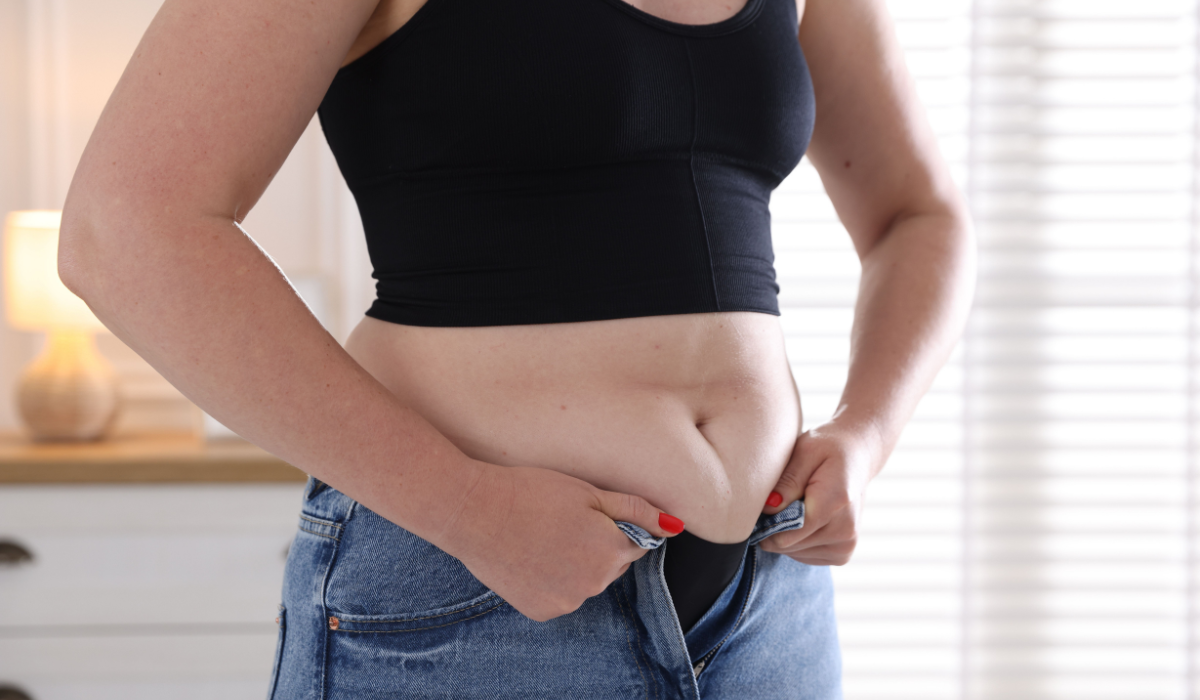
Estrogen decides where your body puts fat. Before perimenopause, this hormone sends fat to your hips, thighs, and buttocks. When estrogen levels drop, fat heads straight to your abdomen instead.
The numbers tell the story. Obesity rates jump to 65% in women between ages 40 and 59, climbing to 73.8% after age 60. This is not about willpower or lifestyle changes.
The fat that shows up around your middle is different from the fat that sits under your skin. This new abdominal fat wraps around your organs as visceral fat. It is more dangerous and harder to lose.
Estrogen controls how your body processes glucose and burns fat through specific enzymes and transport systems. When estrogen drops, your body loses its ability to burn fat efficiently. Research shows that estrogen improves fat burning in muscle tissue through cellular signaling pathways.
Lower estrogen means your fat-burning capacity drops.
Estrogen also influences proteins that fat cells produce to regulate metabolism. The hormone helps control appetite by affecting leptin receptors. When estrogen declines, appetite regulation fails. Fat cells start producing more inflammatory signals.
Progesterone Creates a Weight Loss Paradox
Progesterone raises your metabolic rate and body temperature. This sounds helpful for weight loss.
The reality is more complicated.
During your cycle, progesterone increases insulin resistance and makes it harder for your body to use glucose properly. This hormone tells your pancreas to produce more insulin while making your muscles and fat cells less responsive to it.
Progesterone can also increase appetite, especially when estrogen levels are too low to balance it out. The hormone affects how your body stores fat in specific areas.
These monthly fluctuations make weight management unpredictable as you approach menopause.
Insulin Resistance Drives Weight Gain
Insulin resistance develops when your cells stop listening to insulin signals. Your pancreas responds by making more insulin.
Extra insulin tells your body to store calories as fat, particularly around your midsection.
A recent study of nearly 1,000 women found that early menopausal women had higher insulin resistance rates. Waist-to-hip ratio was the most reliable predictor.
Estrogen normally helps your cells respond to insulin properly. When estrogen drops during menopause, insulin resistance gets worse. Even proteins made by your liver that help with insulin sensitivity decline when hormones shift.
This explains why hormonal weight gain after 40 is about metabolic dysfunction, not lifestyle choices.
Your body is responding to different signals than it did in your 20s and 30s.
What Really Changes After 40
Your body starts working differently after 40, but most people focus on the wrong changes.
Everyone talks about slower metabolism. The real issue is that your body composition shifts in two directions at once: muscle disappears while fat moves to new places.
Between ages 40 and 66, your body gains weight at 0.3 to 0.5 kg per year while body fat increases by 1% annually. These numbers tell only part of the story.
Your Muscle Mass Quietly Disappears
Muscle loss begins during your fourth decade, but it happens so gradually that most people never notice.
Muscle mass decreases 3% to 8% per decade after age 30, accelerating after 60. By age 60, you lose approximately 0.7% to 0.8% of muscle per year in both locomotive and postural muscles.
Here’s what makes this concerning: strength disappears faster than muscle.
You lose 2.5% to 4% of strength annually, substantially more than the 1% muscle loss rate. This means your muscles become weaker before they become smaller.
Muscle burns more calories at rest than fat. When muscle disappears, resting energy expenditure decreases by approximately 4 kcal per year even after adjusting for body composition changes.
Think of it like this: losing muscle is like turning down your body’s thermostat. The furnace still works, but it burns less fuel.
Fat Finds New Places to Settle
Fat redistribution after 40 follows a predictable pattern that has nothing to do with diet choices.
Older women have 300% more visceral fat than young women, while older men have over twice as much. This pattern differs from overall body fat distribution: older women show only 20% greater upper body subcutaneous fat and 45% more leg fat compared to younger women.
The fat that used to settle in your hips and thighs now accumulates around your organs.
Women gain an average of 1.5 pounds per year starting in their mid-40s. Subcutaneous fat converts to visceral fat during menopause, surrounding organs like the stomach, liver, and intestines rather than sitting beneath the skin.
This shift happens because hormones control where fat goes, not how much you eat.
Poor Sleep Creates a Perfect Storm
Sleep problems accelerate both muscle loss and fat gain simultaneously.
Chronic sleep duration of 6 hours or less associates with higher body mass index. Sleep deprivation increases obesity risk by 38% in adults. Poor sleep alters appetite-regulating hormones: ghrelin increases by 24% while leptin drops, creating constant hunger.
Sleep restriction for just 5 days can trigger short-term weight gain.
The problem gets worse when cortisol enters the picture.
Inadequate sleep elevates cortisol levels. High cortisol promotes visceral fat storage around your abdomen while breaking down muscle tissue to release amino acids for energy.
This creates a cycle where poor sleep reduces muscle mass and increases belly fat simultaneously. Your body literally tears down muscle to feed itself while storing fat around your middle.
Most people try to fix their weight without addressing their sleep.
They wonder why nothing works.
Most Weight Loss Advice Stops Working After 40. Here’s Why
The strategies that helped you lose weight in your 20s and 30s often backfire after 40. This is not about willpower or motivation.
Your metabolism has fundamentally changed.
Insulin Resistance Quietly Takes Over
Insulin resistance accelerates during perimenopause as declining estrogen levels directly reduce your cells’ insulin sensitivity. From your late 30s onward, muscle mass naturally declines unless actively maintained.
This matters because skeletal muscle is your body’s largest insulin-sensitive tissue and the primary site where glucose gets stored after meals. Less muscle means fewer places for glucose to go, making blood sugar regulation harder and increasing insulin demand even if your diet stays the same.
Think of it like this: Your muscle tissue acts like a glucose parking lot. When you lose muscle, you lose parking spaces. The glucose has nowhere to go, so it gets stored as fat instead.
Chronically elevated cortisol from poor sleep raises blood sugar levels and worsens insulin resistance. Stress and sleep disruption often accompany perimenopause, which means “just eat less and exercise more” backfires during this stage of life.
Cardio Alone Actually Breaks Down Muscle
Cardio burns calories but doesn’t discriminate between muscle and fat.
Intense, prolonged cardio sessions without adequate nutrition or recovery lead to muscle tissue breakdown. The process accelerates when you push intensity or duration without balancing it with proper fuel or strength training.
Endurance training improves stamina but doesn’t meaningfully challenge the systems needed to preserve muscle quality and strength. Cardio prioritizes submaximal, repeated contractions rather than high-threshold motor unit recruitment necessary for maintaining functional capacity.
When you lose muscle, your metabolism slows down. More cardio means less muscle means slower metabolism.
Your Body Fights Back Against Severe Calorie Restriction
Calorie restriction induces metabolic adaptation, a reduction in energy expenditure larger than fat and muscle loss can explain. Research shows metabolic adaptation reached 8% at 3 months during sleep and nearly double in free-living conditions.
Weight loss stops around the 12-month mark as appetite ramps up to counteract your efforts. Your body prompts you to eat back lost calories, with appetite increasing proportionally to weight lost.
Your body interprets extreme calorie restriction as starvation. It responds by slowing your metabolism and ramping up hunger signals to protect you from what it perceives as a threat.
This survival mechanism worked well when food was scarce. It works against you when you are trying to lose weight in midlife.
What Actually Works When Hormones Change
The good news is that understanding what is happening makes it possible to work with your body instead of against it.
Strength Training Rebuilds What Hormones Break Down
Muscle tissue is where most of your glucose gets stored after meals. When you lose muscle, you lose insulin sensitivity.
Strength training reverses this process.
Research shows that resistance exercise increases insulin action in skeletal muscle. Men who did moderate or high strength training had 2.42 to 2.50 times lower odds of insulin resistance compared to those who did none. The blood sugar benefits last up to 24 hours after your workout.
You do not need heavy weights to start. Even 1-, 2-, or 3-pound dumbbells can make a difference based on where you are now. Studies show that training just two sessions weekly for 16 weeks improved insulin sensitivity and reduced belly fat in adults around 65 with type 2 diabetes.
Think of strength training as hormone therapy you can do yourself.
Protein Timing Matters More Than Calorie Math
Your body processes protein differently as you age. Getting enough becomes more important, but when you eat it matters too.
Successful dieters consumed about 80 grams of protein and 20 grams of fiber daily. Protein has a thermic effect of 25% to 30%, meaning your body burns more calories digesting it compared to carbs at 6% to 8% or fat at 2% to 3%. High-protein diets boost metabolism by 80 to 100 calories daily.
Spreading protein across meals works better than saving it for dinner. Even distribution resulted in 25% greater muscle protein synthesis compared to concentrating intake at one meal.
Sleep and Stress Are Not Optional
Poor sleep spikes cortisol the next day, triggering cravings and lower energy. This is not a willpower problem. It is a hormone problem.
Aim for 7 to 9 hours nightly. Keep consistent bedtimes and avoid caffeine 6 hours before sleep. Blood sugar crashes also trigger cortisol spikes, so eat protein, fiber, and healthy fats every 4 to 6 hours.
Moderate exercise like strength training and walking lower cortisol. Excessive intense training without rest keeps levels elevated.
When Lifestyle Changes Are Not Enough
Sometimes hormones need direct support.
Postmenopausal women using hormone therapy lost 35% more weight on tirzepatide compared to those without. Women on hormone therapy with semaglutide achieved 16% total body weight loss at 12 months versus 12% without.
Hormone therapy may improve outcomes by relieving symptoms that disrupt sleep and quality of life, making dietary and activity changes easier to sustain. Estrogen alone will not cause weight loss but may help redistribute fat away from the abdomen.
The key is working with a practitioner who understands how hormones affect metabolism during this stage of life.
Conclusion
Weight loss after 40 requires a different approach for one simple reason: your hormones have changed. Traditional calorie restriction and cardio won’t work because they don’t address insulin resistance, muscle loss, or the metabolic shifts you’re experiencing.
Strength training, strategic protein intake, and sleep management target the root causes rather than symptoms. Hormone therapy can help when lifestyle changes aren’t enough. Once you understand that hormones drive weight gain during this phase, you can stop blaming yourself and start using strategies that actually work.